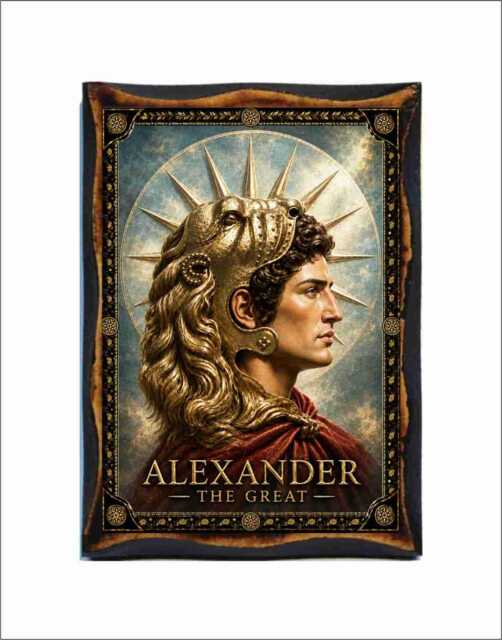
FEDEX FASTER & SAFER LINK BELOW https://www.etsy.com/your/shops/AgioErgo/tools/listings/893744645 Free shipping worldwide with tracking number Dimensions: 11 x 8 cm - 4.33x3.14in , 15 x 11 cm - 5.9x4.33in , 21 x 15 cm - 8.3x5.9in , 27 x 21 cm - 10.6 X8.3in - 42 x 32 cm - 16.5x12.60in Alexander III of Macedon, commonly known as Alexander the Great, was one of the most significant & influential figures in history. He was born in 356 BCE in Pella, the ancient capital of Macedonia, & was the son of King Philip II of Macedon & Queen Olympias. Alexander is renowned for creating one of the largest empires in the ancient world, extending from Greece to Egypt & as far east as India. Early Life & Education Alexander was tutored by the philosopher Aristotle, one of the greatest minds of the ancient world. Under Aristotle's guidance, Alexander developed a love for learning, especially in subjects such as philosophy, science, & literature. His education helped shape his approach to leadership & his belief in the spread of Greek culture, which would later influence the regions he conquered. At a young age, Alexander showed signs of leadership & military skill. When he was just 16 years old, his father, Philip II, left him in charge of Macedonia as regent while he waged a campaign. During this time, Alexander successfully quelled a rebellion & even founded a city, Alexandria. Ascension to the Throne in 336 BCE, Alexander's father, Philip II, was assassinated, & Alexander ascended to the throne at the age of 20. Despite his youth, he quickly proved his ability as a military leader, consolidating power & eliminating any threats to his rule. Military Campaigns & Conquests Alexander's ambition was boundless, & he sought to create an empire that would rival that of any known kingdom. His first major campaign was against the Persian Empire, one of the largest & most powerful empires of the time, which was ruled by King Darius III. Battle of Granicus (334 BCE): Alexander defeated the Persian forces on the banks of the Granicus River in Asia Minor, marking the beginning of his conquest of the Persian Empire. Battle of Issus (333 BCE): in one of his most famous battles, Alexander defeated Darius III, forcing the Persian king to flee. The victory solidified Alexander's control over Asia Minor & allowed him to capture key cities. Siege of Tyre (332 BCE): One of his most remarkable feats was the siege of the island city of Tyre, which resisted for months. Alexander eventually breached the city & gained control of it, demonstrating his military genius. Conquest of Egypt (332 BCE): After the fall of Tyre, Alexander turned south & conquered Egypt, where he was hailed as a liberator. He founded the city of Alexandria, which would later become a major center of culture, trade, & learning. Battle of Gaugamela (331 BCE): The decisive battle between Alexander & Darius III took place in 331 BCE near Gaugamela (modern-day Iraq). Alexander's army decisively defeated the Persians, leading to the collapse of the Persian Empire & the expansion of Alexander's empire into Mesopotamia, Persia, & beyond. India & the Battle of the Hydaspes (326 BCE): Alexander crossed into India & fought King Porus at the Hydaspes River (modern-day Pakistan). Despite facing elephants & a formidable Indian army, Alexander emerged victorious, expanding his empire into the Indian subcontinent. However, after this victory, his troops, weary from years of campaigning, refused to march further east, & Alexander was forced to turn back. Legacy Alexander died in 323 BCE in Babylon at the age of 32, under mysterious circumstances. Some theories suggest that he succumbed to a fever (possibly caused by malaria or typhoid), while others propose that he was poisoned. His sudden death led to the fragmentation of his empire, which was divided among his generals, known as the Diadochi. Despite the short-lived nature of his empire, Alexander's impact was profound. He spread Hellenistic culture throughout the regions he conquered, blending Greek, Persian, Egyptian, & Indian cultures into a rich & diverse cultural mosaic. His cities, most notably Alexandria in Egypt, became centers of learning, trade, & culture. Alexander's military tactics & strategies are still studied in military academies worldwide, & his name has become synonymous with greatness. He is remembered not only as a brilliant conqueror but also as a figure who sought to unite the known world through a fusion of cultures