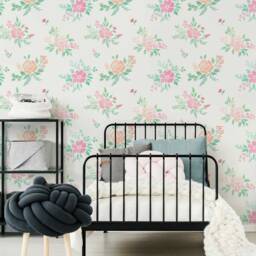
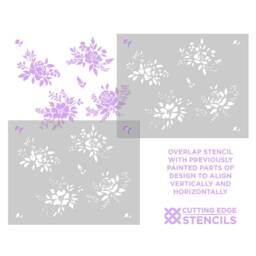
Our Garden Bouquet stencil is a perfect choice for a romantic feminine bedroom or a nursery! Florals & botanicals are everywhere & we're especially fond of large florals & watercolor flowers. Now with the help of our botanical floral stencil & some acrylic or latex paint, your walls can be transformed into a dreamy garden. Unlike pricey floral wallpaper, our reusable flower stencil offers you an opportunity to choose your own color combinations & to be creative. Try this floral wall pattern for a bedroom wall, a bath or the nursery. This floral stencil is created by stencil designer Janna Makaeva & is exclusive to Cutting Edge Stencils. While it takes a stencil artist to draw a good stencil, stenciling itself is an easy painting technique that doesn't require any artistic ability. As long as you can hold a brush or a roller, you're pretty much good to stencil! This stencil design can be painted with a foam roller and/or stencil brushes, depending if you want it in one color or multi-color. If you're looking to achieve a watercolor look with your stencil, please use a floating/glazing medium (sold in craft stores) mixed with your paint, to add translucency. Please watch our videos to learn an easy stenciling watercolor technique. For stencil registration please refer to the step-by step photos above. We offer this stencil design in 2 sizes, choose the large stencil for large scale blooms. Single overlay stencil. SMALL Design size: 22 x 26.25 LARGE Design size: 32.75 x 39.25 Try this stencil with our almost famous Clip-on Stencil Level, (sold separately) & discover how easy it is to achieve perfectly level results without dealing with those bulky & heavy bubble levels. The lightweight level simply clips to the stencil & stays put though your entire project! So easy. Want to learn how to stencil an interlocking allover pattern? Here are the detailed illustrated step-by-step Damask/Allover Stenciling Tips. Please make sure you watch our short step-by-step Video Tutorials! You'll find them extremely helpful for your stenciling project. Even beginners get great results! You can stencil with acrylic or latex paint, stencil creams, fabric paint or glaze. Use a foam roller or stencil brush. Although our stencils do not require the use of spray adhesive, this pattern could benefit from it to help minimize paint seepage, especially if your walls have a slight texture to them. (Elmer's spray adhesive seems to be the best). Make sure you shake the can well & lightly mist (not drench) the stencil, & let it dry for a moment before positioning it on the wall. This step will prevent the adhesive residue transferring to the wall. You'll need to re-mist the stencil after a few repeats. Note: you will still need to hold the stencil in place with a few pieces of blue painters tape! Adhesive by itself is not enough to hold the stencil on the wall. Clean-up tip: Spray the stencil with Simple Green to help to remove adhesive residue. Please note that once you've used spray adhesive on your stencil, it will never really come off completely. That is why we personally prefer not to use adhesive, & instead use less paint on your roller or stencil brush. IMPORTANT INFO ON STENCILING TEXTURED WALLS: in general, it's possible to stencil over textured surfaces, however it depends on the roughness of your texture & your desired outcome. Some textures are really rough, with huge peaks & valleys and, if this is your case, stenciling may not be an option. However, there are light to medium textures that are very suitable for stenciling. With textures it is especially important that you put very little paint on your brush & always off-load it onto a paper towel. Use a rubbing/dabbing motion while stenciling & try not to force the paint under the edges of the stencil. You can also use a dense foam roller, but make sure that you off-load it onto some paper towels so that it is relatively dry. To avoid seepage, use very little paint, & don't press hard on the roller. Using spray adhesive can also help prevent seepage of paint under the stencils. We love Elmer's re-positionable spray adhesive but most re-positionable spray adhesives are fine. Always test the stencil on a disposable surface first (such as a piece of cardboard), or try stenciling a small area in a corner somewhere & immediately wipe the stenciled paint off the wall with a moist baby wipe. Also, it's good to remember that using high-contrast colors (like black over white) is much less