uFurnish - The Home for Furniture Discovery
Circles & The Golden Ratio - image 1
Circles & The Golden Ratio - thumbnail 1
Circles & The Golden Ratio - thumbnail 2
Circles & The Golden Ratio - thumbnail 3
Circles & The Golden Ratio - thumbnail 4
Circles & The Golden Ratio - thumbnail 5

Circles & The Golden Ratio

Etsy logo
By Etsy
£153.74

Sorry, this product is not available in this country.

Similar products


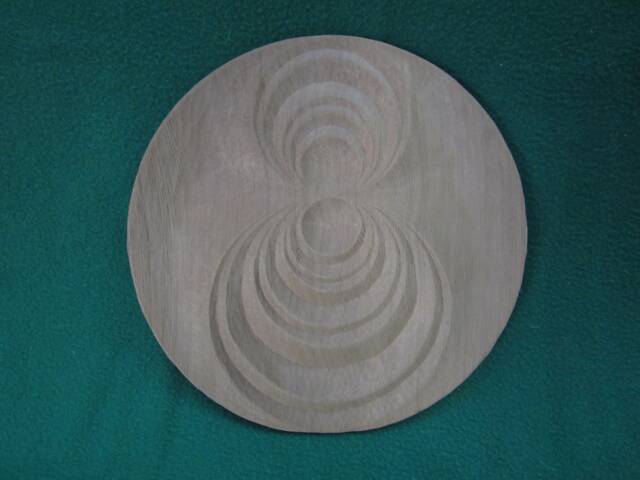
This relief carving was inspired by the Golden Ratio, & brought to life with the interplay of circles. The pattern can first be seen as the largest containing circle, with two circles inside of it, stacked on top of each other; a smaller circle on top of a larger one. These three circles are in a Golden Ratio to each other. This 'stack up' then creates a vertical axis, on which all the remaining circles are centered. It is now the spaces in between all of these other circles that are showcasing the Golden Ratio. This piece is 9 inches across & is 5/8 inch thick. It is carved from a lovely piece of salvaged Old Growth Western Red Cedar. Like all of my wood carvings, it has been completely hand carved. This piece is intended to be a wall hanging, with standard picture-frame-hangar included. The Golden Ratio, 0.618 to 1.0 or 1.0 to 1.618 is a proportion found all over nature, as well as in most living beings on this planet. The double spiral pattern found in many plants typically consists of two spirals of consecutive Fibonacci numbers; like 8 spirals one way & 13 spirals the other way, or 21 spirals one way & 34 the other way. Fibonacci numbers are numbers from a number sequence that begins with 0 & 1, & then continues 1, 2, 3, 5, 8, 13, 21, 34, etc. You add the two previous numbers to get the next number; 0+1=1, 1+1=2, 2+1=3, 3+2=5, etc. Each pair of consecutive numbers approximates the Golden Ratio of 1.618... or 0.618...(depending on which way you're dividing). Divide two consecutive numbers, you get an approximation of the Golden Ratio, but more than the 'real' ratio. Divide the next two numbers, you get a closer approximation, but less than the 'real' ratio. Divide the next two numbers, get an even closer approximation, but more than the ratio. Above, below, above, below, & ever closer each time. Such amazing beauty! & what an analogy to our trials & tribulations in this life, eh!? What some might call Karma. We have our ups & downs, but ultimately are always along our trajectories towards that which is greater than all of us. Up, down, up, down, & always twirling, twirling towards freedom! The Golden Ratio (also known by the Greek letter Phi) is an 'irrational number', just like Pi, because it never ends, & as such it cannot ever be calculated exactly. The number goes on to infinity. I've heard it said that the Golden Ratio is actually the most irrational of all the irrational numbers because as all irrational numbers go on to infinity, the Golden Ratio is the slowest to approach infinity due to the fact that it can be written using only the number one; one plus the square root of (one plus the square root of [one plus the square root of {one plus the square root of. . . etc. ad infinitum. Circles & The Golden Ratio

colours

Brown

materials

Western Red Cedar
Estimated Delivery:

Latest delivery information available on the retailer website here.

New to uFurnish.com?

Did you know uFurnish.com looks inside 100+ retailers for you?

See our retailer partners...