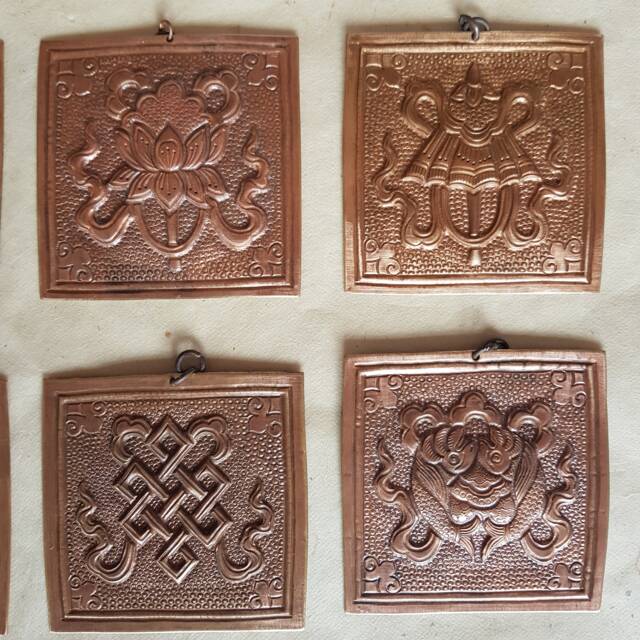
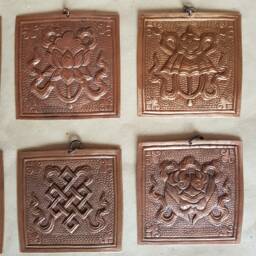
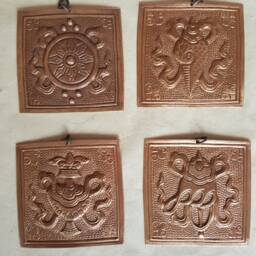
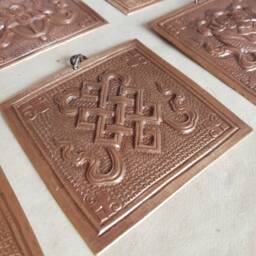
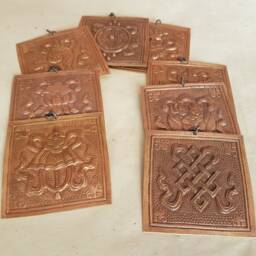
The Ashtamangala are a sacred set of eight auspicious signs or symbols. They are considered a teaching tool, which point to the qualities of enlightenment. Within Buddhism, the Ashtamangala, are symbols of good fortune & represent the offerings made to Buddha by the gods upon gaining enlightenment. Here are the most common interpretations & meaning of each symbol. (by Beatrix Potter) The Conch This symbol, of a white, right-turning conch shell, is representative of the deep, melodious & interpenetrating sound of the dharma. It awakens disciples from their own deep slumber of ignorance & instead, encourages them to not only seek to accomplish their own welfare, but also to strive to realize the welfare of others. The Pair Of Golden Fish The symbol of the pair of golden fish is used to symbolize the auspiciousness of all conscious beings in a state of complete fearlessness. in the same manner in which fish swim freely through the ocean, so too should all living beings live spontaneously & freely as they migrate from one place to another, without fear of drowning in samsara - the perpetual cycle of rebirth, existence & death. The two fish also symbolize happiness, through their complete & utter freedom of movement through the seas, as well as representing fertility & abundance. The Endless Knot The endless knot has a multiplicity of meanings. Ultimately, however, it is a symbol of the unity of everything & the way in which all things are intertwined & linked. The endless knot represents the mutual dependence of secular affairs & religious doctrine. It is also representative of the interdependence of wisdom & compassion in enlightenment, as well as the union of wisdom & method. The Lotus The lotus flower is a symbol of complete purity & rejection of all desecrations of the body, mind & speech. The lotus flower, which has its roots in the mud, deep at the bottom of the pond, nonetheless grows & is able to float immaculately & in sheer purity above the muddy waters. So too, can one's body, speech & mind learn to be free of desire & attachments. The bloom of a Buddhist lotus has 4, 8, 16, 24, 32, 61, 100 or 1,000 petals & these same numbers can correspond to the body's chakras. or energy centers. The Parasol The symbol of the jeweled or precious parasol represents the protection of all beings from harmful forces, illnesses, disease & the obstacles confronted during this life. The parasol further symbolizes the protective quality of the seventh primary chakra, the Sahasrara. As such, all may seek refuge beneath the auspiciousness of the parasol. The Dharmachakra Sometimes referred to as 'Wheel of the Law' or Dharma Wheel, the Dharmachakra is a golden wheel, representative of the Dharma teachings & Gautama Buddha. It represents the auspiciousness of the precious teaching & realization of Buddha's doctrine. It is symbolic of the continuation or turning of the wheel, of the Dharma teachings, across all realms & time. As such, all beings are able to continue to experience the liberation it offers. The Treasure Vase The treasure vase is symbolic of the unlimited quality of the dharma teachings. Regardless of how many teachings Buddha may have shared, the quality & the treasure contained within them was never lessened or weakened. As such, the treasure vase is also symbolic of longevity, wisdom & all the benefits offered in this world, as well as liberation. It further symbolizes wealth, prosperity, long life & health. Due to its representation, the vase or wisdom urn is also often used in many initiations & empowerments. The Victory Banner The dhvaja, or banner, was a standard feature of ancient Indian military warfare. The victory banner is the symbol used to represent the victory of Buddha over the four obstacles which stood in the path of enlightenments - desire, pride, disturbing emotions & ultimately, the fear of death. It is further used to represent the total victory of the Buddhist doctrine over destructive & malevolent forces. The victory banner is also used to symbolize the victory over negativity, challenges & hurdles confronted by each individual & the activities of one's own mind, body & speech in overcoming these. Handmade with love in Kathmandu, Nepal. Please note this is not machine made! Each detail in the metal has been hammered with absolute precision by hand. Thank you for your interest & don't hesitate to contact us if you have any questions. Don't forget to add our shop to your favourites to receive updates