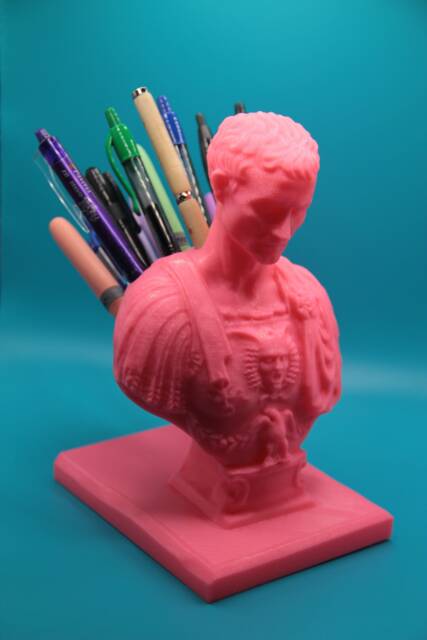
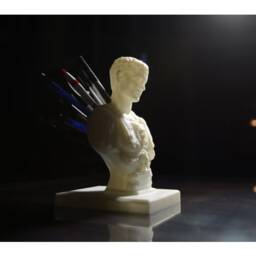
Et tu, Brute??! This is an intricately ornate 3D printed bust of the infamous Julius Caesar, famous for his salad...ok maybe not the salad. But similar to how it actually happened in ancient Rome, you could ironically keep your pens in his back! This humorous desktop pen holder is sure to strike up a conversation to all that enter your dominion. Makes the perfect gift for that one person thats REALLY into history & art. Instantly class up any office with this statue of the most famous Roman leader. HOLDS UP TO 12 PENS! Have Caesar watch over your office as you dominate your work & keep a little history in the back of your mind whenever you reach for your favorite pen: Gaius Julius Caesar, one of the world's greatest military leaders, was born into a senatorial, patrician family & was the nephew of another famous Roman general, Marius. After the death of Marius & the rise of Sulla, Caesar's life was for a time in jeopardy, but in the early 60s b.c. he launched his own successful political & military career. Rising rapidly, he campaigned successfully for the consulship in 60 b.c. & struck a deal with two of Rome's leading figures, Pompey the Great & Crassus. Together the three of them became known as the First Triumvirate & controlled Rome throughout the 50s b.c., until Caesar & Pompey, after Crassus's death, went to war against one another in 49 b.c. Did You Know? Unlike in the Shakespeare play, Caesar's last words were not Et tu, Brute? (And you, Brutus?). Instead they were reported as You, too, my child? During the heyday of the First Triumvirate, Caesar devoted his energies to the conquest of Gaul (modern France). After serving as consul in 59 b.c., Caesar became governor of Cisalpine & Transalpine Gaul (northern Italy & southern France, respectively). in 58, when the Helvetii in Switzerland attempted to migrate into central Gaul, Caesar decided that they would be a threat to the Roman province, & in a great battle he stopped their advance & sent them back into their homeland. in the meantime he had become friendly with the chieftains of central Gaul, & they urged him to protect them against a German invader from across the Rhine, Ariovistus. So, in the summer of 58, after defeating the Helvetians, Caesar marched against the Germans & drove them out of Gaul. Caesar was by then inextricably involved in the affairs of Gaul. Over the next several years, in a series of brilliant campaigns, the Roman general conquered all of Gaul & made it a Roman province. The conquest required several difficult battles in northern Gaul & the crossing of the Rhine over a trestle bridge constructed by Roman engineers. in the summers of 55 & 54 b.c., Caesar sailed across the English Channel, thereby securing his northern flank along the Rhine in Gaul by precluding a Celtic attack from across the Channel, though Britain did not become a Roman province for another hundred years. After dealing with a major revolt by Gallic chieftains, including Caesar's famous siege of Vercingetorix's bastion at Alesia in 52 b.c., the Roman leader brought resistance to an end in 51 & 50 b.c. Early in 49, as his command in Gaul was coming to an end, Caesar began civil war with his old associate, Pompey the Great, who had allied himself with the Roman Senate against Caesar. in a surprising blitzkrieg, Caesar invaded Italy & drove Pompey into Macedonia in less than seventy days. Since Pompey had a fleet & Caesar did not, Caesar decided to attack Spain, where Pompey had strong support, while Caesar's men constructed warships. Victorious in Spain, Caesar then sailed to Macedonia, but he could not dislodge Pompey from his base at Dyrrhachium (modern Durazzo). Caesar finally raised the siege, fell back into central Greece, & defeated Pompey, who had pursued him, at the Battle of Pharsalus in 48 b.c. Caesar was then drawn into an affair with Cleopatra in Egypt & finally had to fight two more battles with the Pompeians, one in North Africa (Thapsus, 46 b.c.) & another in Spain (Munda, 45 b.c.). Triumphant all over the Mediterranean, the great general was assassinated by political rivals on the Ides of March in 44 b.c., as he prepared an invasion of the Parthian Empire. His generalship was characterized by boldness, decisiveness, & a sometimes reckless willingness to move ahead of his supply lines. Model by derailed. The Original Julius Caesar 14 Pen & Pencil Holder