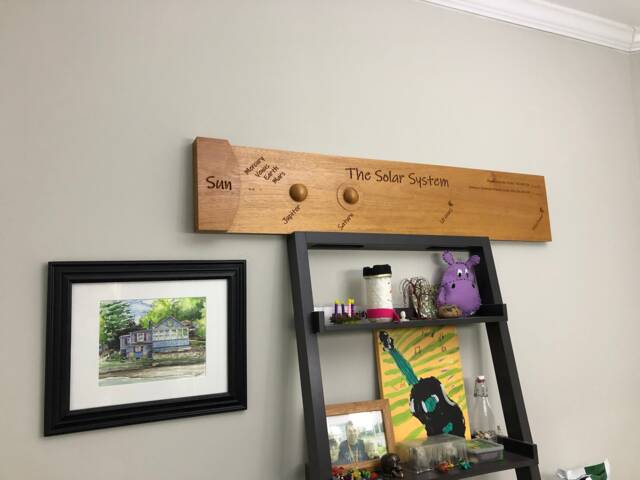
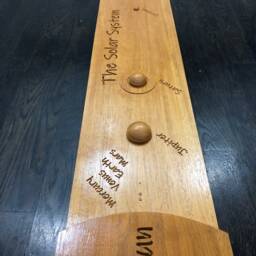
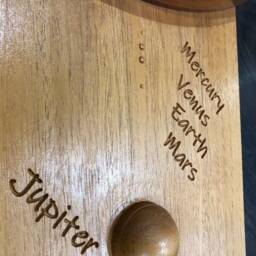
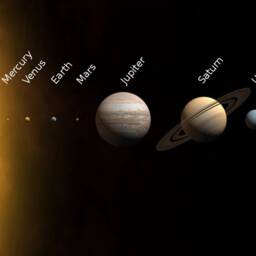
The Solar System presented in a way that's sure to make a lasting impression! Makes a great gift as a conversation piece around the house or for the teacher in your life. This item is carved from a single solid piece of mahogany & finished with lacquer for lasting beauty & protection. Planet sizes (and the Sun) are to scale with each other. Distances between each are also to scale, albeit a different scale. Scales are engraved on the piece for reference. Dimensions: 47.25 x 9 x 1.75 inches The Solar System formed 4.6 billion years ago from the gravitational collapse of a giant interstellar molecular cloud. The vast majority of the system's mass is in the Sun, with the majority of the remaining mass contained in Jupiter. The four smaller inner planets, Mercury, Venus, Earth & Mars, are terrestrial planets, being primarily composed of rock & metal. The four outer planets are giant planets, being substantially more massive than the terrestrials. The two largest, Jupiter & Saturn, are gas giants, being composed mainly of hydrogen & helium; the two outermost planets, Uranus & Neptune, are ice giants, being composed mostly of substances with relatively high melting points compared with hydrogen & helium, called volatiles, such as water, ammonia & methane. The distance from Earth to the Sun is 1 astronomical unit [AU] (150,000,000 km; 93,000,000 mi). For comparison, the radius of the Sun is 0.0047 AU (700,000 km). Thus, the Sun occupies 0.00001% (105 %) of the volume of a sphere with a radius the size of Earth's orbit, whereas Earth's volume is roughly one millionth (106) that of the Sun. Jupiter, the largest planet, is 5.2 astronomical units (780,000,000 km) from the Sun & has a radius of 71,000 km (0.00047 AU), whereas the most distant planet, Neptune, is 30 AU (4.5109 km) from the Sun. With a few exceptions, the farther a planet or belt is from the Sun, the larger the distance between its orbit & the orbit of the next nearer object to the Sun. For example, Venus is approximately 0.33 AU farther out from the Sun than Mercury, whereas Saturn is 4.3 AU out from Jupiter, & Neptune lies 10.5 AU out from Uranus. Attempts have been made to determine a relationship between these orbital distances (for example, the Titius-Bode law), but no such theory has been accepted. The images at the beginning of this section show the orbits of the various constituents of the Solar System on different scales. Some Solar System models attempt to convey the relative scales involved in the Solar System on human terms. Some are small in scale (and may be mechanicalcalled orreries)whereas others extend across cities or regional areas. The largest such scale model, the Sweden Solar System, uses the 110-metre (361 ft) Ericsson Globe in Stockholm as its substitute Sun, and, following the scale, Jupiter is a 7.5-metre (25-foot) sphere at Arlanda International Airport, 40 km (25 mi) away, whereas the farthest current object, Sedna, is a 10 cm (4 in) sphere in Lule, 912 km (567 mi) away. If the Sun-Neptune distance is scaled to 100 metres, then the Sun would be about 3 cm in diameter (roughly two-thirds the diameter of a golf ball), the giant planets would be all smaller than about 3 mm, & Earth's diameter along with that of the other terrestrial planets would be smaller than a flea (0.3 mm) at this scale. The Solar System