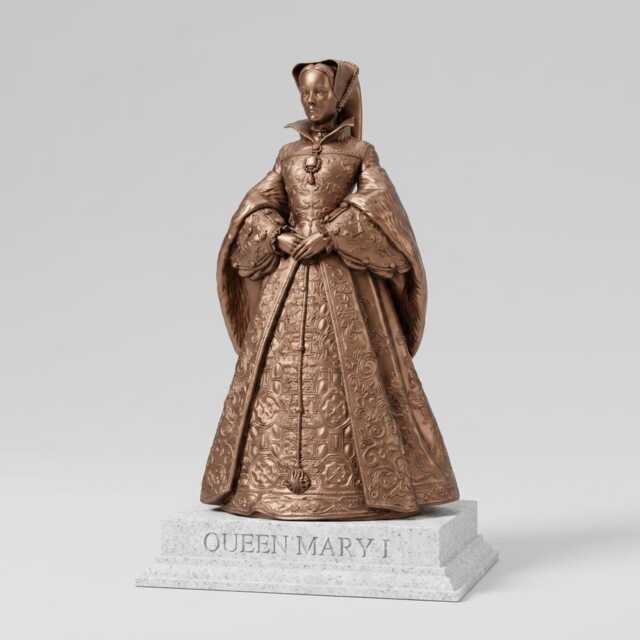
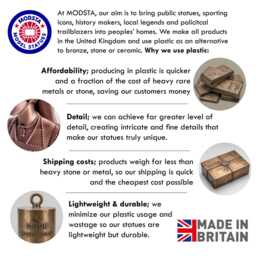
Celebrate the life & legacy of Queen Mary I of England, one of the most controversial monarchs in British history, with this beautifully detailed historical statue. Often remembered by the nickname Bloody Mary, Mary was England's first queen to rule in her own right & played a pivotal role during one of the most turbulent periods of the Tudor dynasty. Born on 18 February 1516, Mary was the only surviving child of King Henry VIII & his first wife, Katherine of Aragon. As a young princess, Mary received an exceptional education, becoming fluent in several languages & developing a deep devotion to the Catholic faith that would define much of her later life. Mary's childhood changed dramatically when Henry VIII sought to annul his marriage to Katherine of Aragon. Refusing to recognise the annulment, Mary was declared illegitimate, separated from her mother & removed from the line of succession. Despite years of hardship, political uncertainty & pressure to abandon her religious beliefs, Mary remained steadfast in her Catholic faith. Following the deaths of her half-brother Edward VI & the brief attempt to place Lady Jane Grey on the throne, Mary secured widespread support & became Queen of England & Ireland in 1553. Her accession marked the first time that a woman ruled England as queen in her own right. in 1554, Mary married Prince Philip of Spain, later King Philip II of Spain, in a marriage intended to strengthen England's alliance with Catholic Spain. The couple had no children, despite Mary's two widely believed false pregnancies. The absence of an heir ultimately meant that the Tudor crown would pass to her half-sister, Elizabeth. Mary is best known for her determined attempt to restore Roman Catholicism as England's official religion following the Protestant reforms introduced by her father & brother. During her reign, around 280 Protestant men & women were executed for heresy, leading later Protestant writers to give her the enduring nickname Bloody Mary. Modern historians often place these events within the wider context of 16th-century religious conflict, when persecution occurred across Europe under both Catholic & Protestant rulers. Despite the controversy surrounding her reign, Mary also strengthened England's navy, improved government finances & laid foundations that benefited later Tudor monarchs. Today, historians continue to reassess her reign, recognising both her determination & the immense political & religious challenges she faced. Queen Mary I died on 17 November 1558 at St James's Palace, London, aged 42. She was succeeded by her half-sister Queen Elizabeth I, ushering in the Elizabethan era. Mary is buried in Westminster Abbey, where she shares a tomb with Elizabeth I. Statue Details Standing approximately 23cm tall, this finely detailed Queen Mary I statue is produced in durable bronze effect plastic, recreating the appearance of a traditional bronze sculpture while remaining lightweight, durable & affordable. Carefully sculpted to reflect Mary's regal appearance & Tudor dress, the statue makes an impressive display piece for collectors of British royal history, Tudor memorabilia & historical figures. Why Collect Queen Mary I? Queen Mary I remains one of Britain's most fascinating & debated monarchs. Whether remembered as the first reigning Queen of England, a determined Catholic monarch, or through the enduring legend of Bloody Mary, her reign marked a turning point in English history. Her life has inspired countless books, documentaries, films & historical studies, making her an enduring subject for collectors of Tudor history. This statue serves as a tribute to a queen whose courage, convictions & controversial legacy continue to fascinate historians & enthusiasts around the world. Why Modsta Uses Bronze Effect Plastic At Modsta, our aim is to create beautifully detailed statues of historical figures that are affordable, quick to manufacture & economical to post. Traditional sculptures made from bronze, brass or heavy stone are often expensive to produce, difficult to transport & costly for collectors. By using modern bronze effect plastics, we can achieve exceptional levels of sculptural detail while making historical collectibles accessible to a wider audience. Plastic faithfully reproduces intricate facial features, Tudor clothing, jewellery & decorative details with impressive precision. The lightweight nature of plastic significantly reduces postage costs compared with bronze or