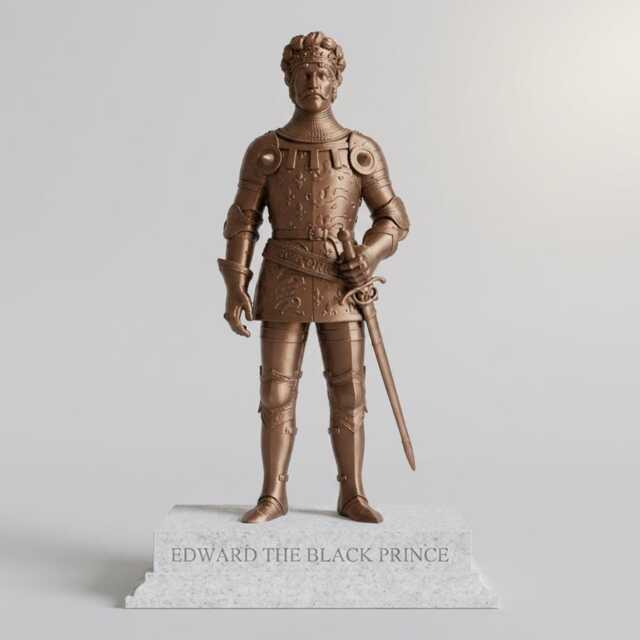
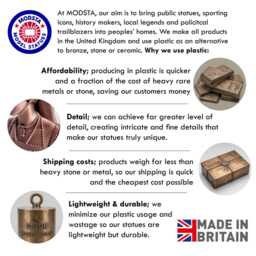
Celebrate the life & legacy of Edward of Woodstock, better known as Edward the Black Prince, with this beautifully detailed historical statue. Regarded as one of the greatest military commanders of medieval England, the Black Prince earned legendary status through his victories during the Hundred Years' War & remains one of the most admired figures of the Plantagenet dynasty. Born on 15 June 1330 at Woodstock Palace, Edward was the eldest son of King Edward III & Philippa of Hainault. As heir to the English throne, he was created Prince of Wales at the age of just seven, becoming the first English prince to formally hold the title. From an early age, he received extensive training in warfare, leadership & chivalry, preparing him for a life of military command. Edward first achieved lasting fame during the Battle of Crcy in 1346, where, at only sixteen years old, he commanded part of the English army. Despite coming under heavy attack from the French, he held his position with remarkable courage & helped secure one of England's greatest medieval victories. His conduct at Crcy established his reputation as an outstanding battlefield commander. Ten years later, the Black Prince won another famous victory at the Battle of Poitiers in 1356, where his smaller English force defeated a much larger French army & captured King John II of France. This extraordinary achievement made Edward one of the most celebrated military leaders in Europe & further strengthened England's position during the Hundred Years' War. Edward married Joan of Kent, often known as The Fair Maid of Kent, in 1361. The couple had two sons: Edward of Angoulme, who sadly died in childhood, & Richard of Bordeaux, who later became King Richard II of England. Although remembered for his military brilliance, Edward also served as Prince of Aquitaine, governing English territories in France. His later campaigns in Spain included victory at the Battle of Njera in 1367, although the campaign placed enormous financial strain on his administration. Years of warfare & illness gradually weakened his health. Edward the Black Prince died on 8 June 1376, aged just 45, one year before his father, King Edward III. Because he died before becoming king, he never inherited the English throne. Instead, his son Richard succeeded his grandfather as King Richard II in 1377. The exact origin of the nickname The Black Prince remains uncertain. It first appeared more than a century after his death & may refer to the colour of his armour, his black heraldic shield or his fearsome reputation on the battlefield. Today, Edward the Black Prince is remembered as one of England's greatest medieval warriors & an enduring symbol of knightly courage, leadership & military excellence. His magnificent tomb in Canterbury Cathedral remains one of the finest examples of medieval royal memorials in Britain. Statue Details Standing approximately 25cm tall, this finely detailed Edward the Black Prince statue is produced in durable bronze effect plastic, recreating the appearance of a traditional bronze sculpture while remaining lightweight, durable & affordable. Carefully sculpted to capture the Prince in full medieval armour with the noble bearing for which he became famous, this statue makes a striking display piece for collectors of English history, medieval warfare, Plantagenet royalty & military heroes. Why Collect Edward the Black Prince? Few medieval figures have earned a reputation equal to that of the Black Prince. His victories at Crcy & Poitiers changed the course of the Hundred Years' War & secured his place among history's greatest battlefield commanders. Collectors are drawn to Edward because he embodies the ideals of medieval chivalry, courage & leadership. His life has inspired historians, military scholars, artists & writers for centuries, making him an essential figure in any collection of English monarchs, princes or military legends. Why Modsta Uses Bronze Effect Plastic At Modsta, our aim is to create beautifully detailed statues of historical figures that are affordable, quick to manufacture & economical to post. Traditional sculptures made from bronze, brass or heavy stone are often expensive to produce, difficult to transport & costly for collectors. By using modern bronze effect plastics, we can achieve exceptional levels of sculptural detail while making historical collectibles accessible to a wider audience. Plastic faithfully reproduces intricate armour,