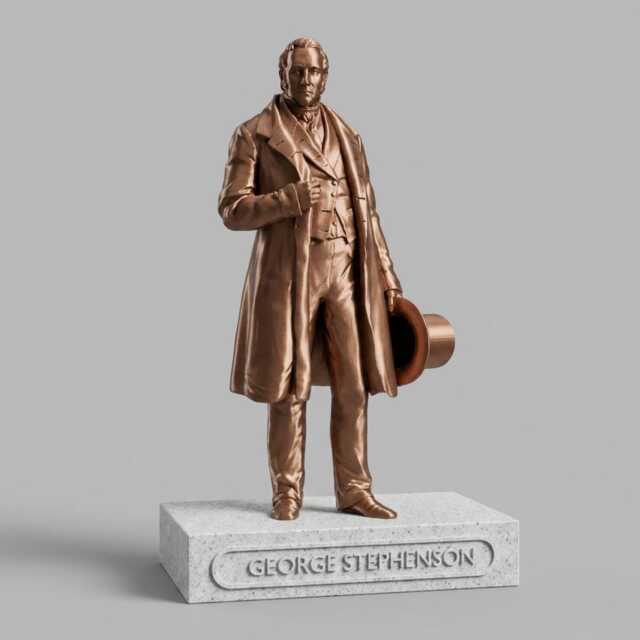
Celebrate the life & achievements of George Stephenson, one of Britain's greatest engineers & one of the most influential innovators of the Industrial Revolution, with this beautifully detailed historical statue. Widely known as the Father of the Railways, Stephenson transformed transport forever through his pioneering work in steam locomotives & railway engineering, helping to shape the modern world. Born on 9 June 1781 in Wylam, Northumberland, George Stephenson came from a humble working-class family. His father worked as a fireman tending steam engines at a local colliery, & George spent much of his childhood around machinery. Despite receiving very little formal education, he taught himself to read & write as a young adult while working as an engine man, demonstrating the determination & curiosity that would define his remarkable career. Stephenson's engineering talent soon became widely recognised. He developed improved steam engines for coal mines before turning his attention to railway locomotives, believing that steam-powered transport could revolutionise industry & travel. in 1814, he built his first successful locomotive, Blcher, capable of hauling heavy loads of coal. However, his greatest achievement came in 1825, when he designed the locomotives & railway for the Stockton & Darlington Railway, the world's first public railway to use steam locomotives for both freight & passengers. This historic opening marked the beginning of the railway age. Stephenson's reputation grew even further with the construction of the Liverpool & Manchester Railway, the world's first fully inter-city passenger railway. His famous locomotive Rocket, designed with his son Robert Stephenson, won the Rainhill Trials in 1829 & demonstrated the enormous potential of steam-powered rail travel. Rocket became one of the most famous locomotives ever built & helped establish the design principles used by steam engines for decades. George Stephenson married Frances Henderson in 1802, & they had one son, Robert Stephenson, who became one of Britain's greatest civil & railway engineers in his own right. Following Frances' death, George later married Elizabeth Hindmarsh. One of Stephenson's most enduring contributions was the adoption of the 4 feet 8 inches (1,435 mm) railway gauge, now known as standard gauge, which remains the most widely used railway track gauge throughout the world. George Stephenson died on 12 August 1848 at the age of 67. His innovations transformed transport, commerce & society, helping to fuel the Industrial Revolution & laying the foundations for modern railway systems across the globe. Today, George Stephenson is remembered as one of Britain's greatest inventors & engineers. His vision, determination & practical genius changed how people travelled, connected cities & accelerated economic growth, leaving a legacy that continues to influence transportation nearly two centuries later. Statue Details Standing approximately 25cm high & 15cm wide, this finely detailed George Stephenson statue is produced in durable bronze effect plastic, recreating the appearance of a traditional bronze sculpture while remaining lightweight, durable & affordable. Carefully sculpted to capture Stephenson's distinguished appearance, this statue honours one of the greatest pioneers of engineering & industrial innovation. It makes an impressive display piece for collectors of railway history, industrial heritage, engineering achievements & British historical figures. Why Collect George Stephenson? Few inventors have transformed everyday life as profoundly as George Stephenson. His pioneering work helped create the modern railway network, connecting towns, cities & nations in ways that had never before been possible. Collectors value George Stephenson memorabilia because it celebrates one of the key figures of the Industrial Revolution & the birth of the railway age. His achievements continue to inspire engineers, railway enthusiasts & historians throughout the world, making this statue a fitting tribute to one of Britain's greatest innovators. Whether displayed in a railway collection, engineering display or historical collection, this statue honours a man whose inventions changed the course of history. Why Modsta Uses Bronze Effect Plastic At Modsta, our aim is to create beautifully detailed statues of historical figures that are affordable, quick to manufacture & economical to post. Traditional sculptures made from bronze, brass or