Choosing new curtains gets easier if you start with the room, not the style name. A bedroom usually needs better light control. A street-facing living room needs privacy without losing daylight. Wide patio doors put pressure on which heading will hang well, and a cold, draughty window can make lining more important than pattern or colour.
That's also how most people search. Interest in blackout curtains tends to stay consistently high across the year, while searches for thermal curtains climb noticeably in the colder months (1). A sign that people are usually looking for a solution to a specific problem before they're looking for a particular curtain heading.
This guide works room-first: what to look for based on the problem you're solving, then how that translates into a heading, a lining and a buying route. If you already know that you want to compare eyelet, pencil pleat, pinch pleat, wave and voile curtains side by side, our guide to the UK's most popular curtain styles covers each one in detail.
Start here: Curtain choice by room
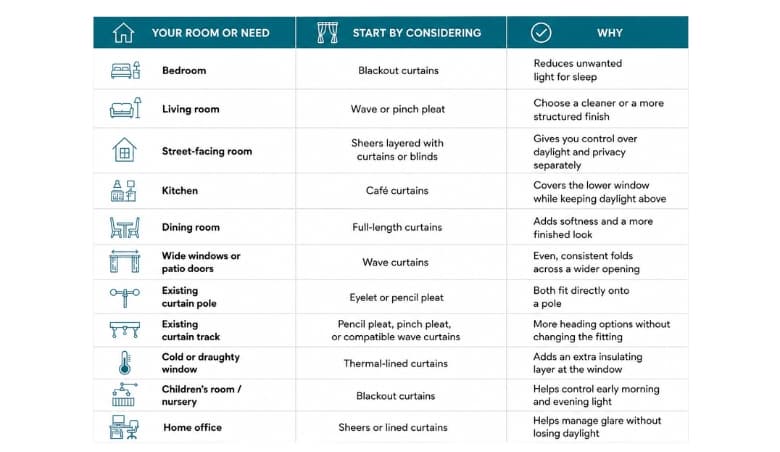
Treat this as a starting point rather than a final answer. A bedroom might need blackout performance, for instance, but you'll still need to decide separately whether that comes in an eyelet, pencil pleat, pinch pleat, or wave heading. Your existing pole or track will usually narrow that down for you before you fall for a particular fabric.
Should you layer sheer curtains with heavier ones?
Layering is one of the more genuinely useful ideas for a street-facing room because it gives you more options as to how you can use a window through the day. A sheer or voile curtain softens daylight and gives some daytime screening on its own. A heavier curtain or blind can then be closed later for full privacy once it's dark outside.
This combination is worth considering if:
- Your living room faces the street
- You want daylight without leaving the window completely bare
- Your privacy needs change between day and night
- A single heavy curtain feels like too much for a large window
The limitation is nighttime privacy: a sheer alone won't screen the room once it's lit inside and dark outside. A second layer is required to do that job.
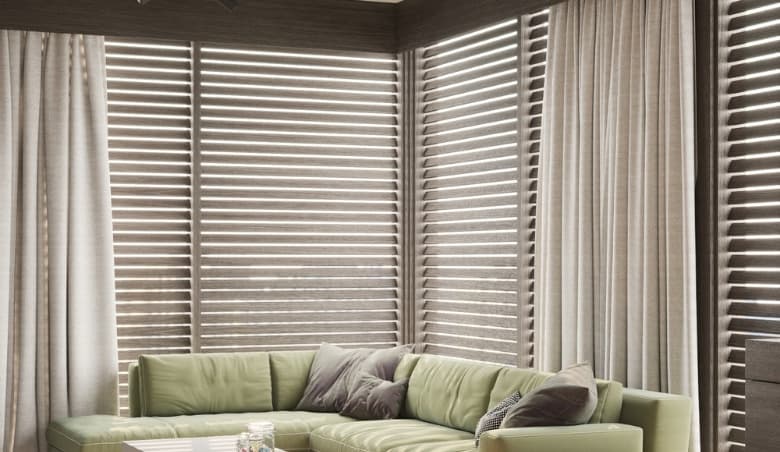
Explore voile curtains and panels if this layered approach suits your window.
Do you need blackout curtains?
For a bedroom, this decision often matters more than the heading you choose. NHS guidance on sleep recommends a bedroom that's quiet, dark, and cool (2). Darkness is one of the more straightforward things to control with the right window coverings. Search data backs this up: blackout curtains consistently attract noticeably more interest than sheer or thermal options (1), suggesting light control is one of the main reasons people search for curtains at all.
Blackout curtains are particularly worth considering for:
- Bedrooms affected by early morning light
- Rooms facing streetlights
- Children's bedrooms and nurseries
- Shift workers sleeping during daylight hours
Most retailers offer blackout linings across the full range of headings. And some, Swift Direct Blinds among them, combine blackout with thermal performance in a single lining so you can choose the performance first and the heading second. When you're comparing options, check the lining spec rather than assuming "thick" and "blackout" mean the same thing.
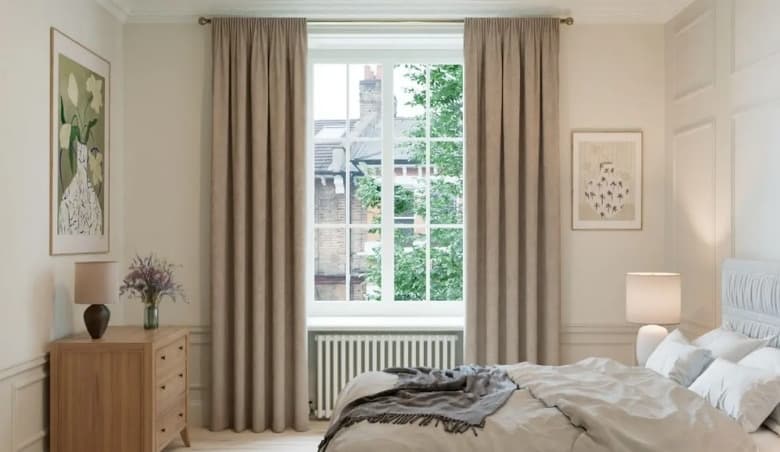
If light control is your priority, compare blackout curtains from 100+ retailers across the UK on uFurnish.com.
When are thermal curtains worth it?
Thermal curtains become more relevant once the window itself feels cold or draughty. The Energy Saving Trust lists heavy, lined curtains among the practical measures that can reduce heat loss through windows, with options like secondary glazing and sealed blinds (3). They recommend closing curtains once it gets dark to help keep the warmth in overnight (4). Search interest reflects this too. Thermal curtain searches are noticeably more seasonal than blackout, picking up during colder months (1).
One detail that's easy to overlook: if you have a radiator under the window, a curtain that hangs down over it can trap warm air behind the fabric instead of letting it circulate into the room. It's generally worth choosing a curtain length that clears the radiator or fitting a shelf above it if warmth is your priority. 'Thermal' and 'blackout' aren't interchangeable. Some curtains combine both, but plenty are built for one purpose only.
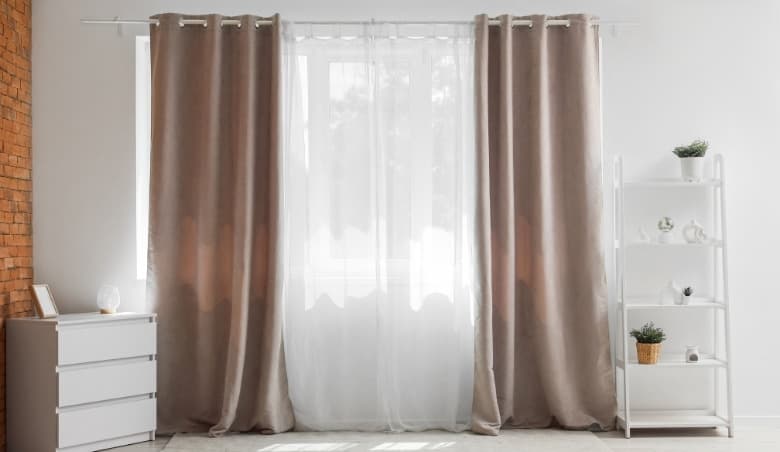
If warmth is your priority, explore thermal curtains from 100+ UK retailers on uFurnish.com.
Which heading suits your hardware?
Once you know the performance curtain you need, your existing pole or track usually decides the rest:
- Already have a pole? Eyelet is the simplest fit. It slides straight onto the pole with no separate hooks. Pencil pleats also work on a pole fitted with rings.
- Already have a track? Pencil pleat and pinch pleat both work well. A wave heading will also need a wave-compatible track.
- Want the most even, streamlined look across a wide window or patio doors? Wave curtains hang in consistent folds and suit larger expanses of glazing.
- Want more structure and definition at the top of the window? Pinch pleats create fixed, tailored folds rather than an adjustable gather.
Most made-to-measure retailers, including Swift Direct Blinds, offer the same fabric across several of these headings. Which makes it easier to compare, say, wave against pinch pleat before deciding. For a full breakdown of how each heading is constructed and hangs, see our guide to the six most popular curtain styles in the UK.
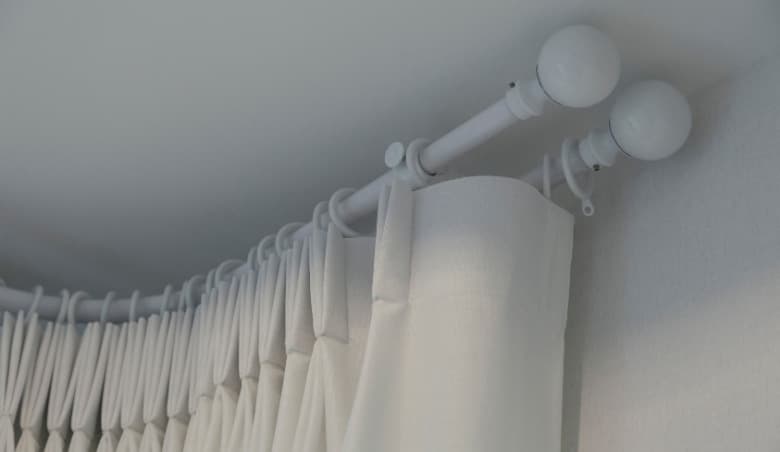
Ready-made or made-to-measure?
Once you know what the curtain needs to do, the next question is whether a standard size will actually fit the window. Ready-made curtains work well when your window falls within common widths and drops. They give you the widest choice if you're simply replacing existing curtains without changing anything else about the window.
Made-to-measure curtains become the better route when:
- The window is wide or tall
- You're covering patio or bi-fold doors
- Standard drops finish in the wrong place on the wall
- You want a specific heading and lining combination that isn't sold ready-made
- You want precise control over the finished fit
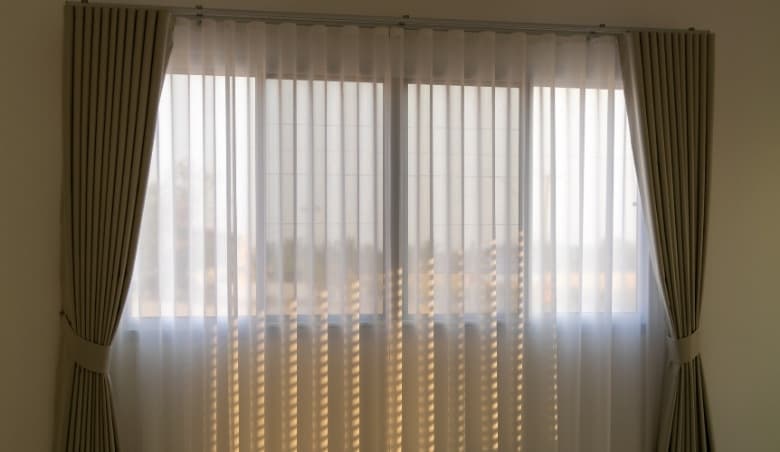
Whichever route you take, it's worth ordering fabric samples before you buy. Swift Direct Blinds, for example, offers free samples on its made-to-measure curtain range. Fabric reads differently next to your walls than it does on a screen. A sample also shows you how much light actually passes through it, which product photos can't tell you.
You won't need made-to-measure curtains for every window. But if ready-made sizes are forcing a compromise on width, drop, or heading, it's worth comparing the cost difference before settling for a fit that's slightly wrong. If you're not sure which retailer to start with, our roundup of the UK's biggest curtain and blind retailers compares specialists and larger home retailers side by side.
How do I know what curtain size I need?
Measure your pole or track, not the window. A few things make the difference between a good and an awkward fit:
- Extend beyond the frame. Where you have the wall space, fit the pole or track 15-20 cm beyond the window frame on each side so that open curtains stack back without covering the glass. Measure the pole or track itself, excluding finials.
- Width isn't the same as fullness. Curtain width should generally be around double your pole or track width for a standard, gathered look. Many pleated headings such as pinch pleats and waves already build this fullness in. So check whether you're ordering flat panel width or finished width.
- Decide the drop first. A sill-length drop sits just above the windowsill. A below-sill drop finishes 10-15 cm past it. A floor-length drop should just clear the floor. Take the drop measurement at both the left and right sides of the window, not just once in the middle. Go with whichever side is shorter, as floors and sills often slope very slightly.
- Eyelet and pencil/pinch pleat measure differently. Eyelet curtains hang directly from rings in the fabric, so measure the drop from the top of the pole. Pencil pleats and pinch pleats hang from separate hooks below the pole. Measure from the bottom of the ring instead. It's a small difference that can leave a curtain sitting noticeably out of place if it's missed.
Curtain trends worth knowing in 2026
Not every interiors trend should influence what you buy, but three current directions are worth knowing because each one changes how a window looks or works, not just how it's styled.
Wave and ripple-style folds: Regular, even wave folds continue to feature strongly in 2026 window-treatment coverage, particularly for larger expanses of glazing and floor-to-ceiling windows (5).

Layering: Sheers paired with heavier curtains or blinds let you adjust light and privacy through the day rather than fixing them in one position. A functional upgrade instead of a purely decorative one.
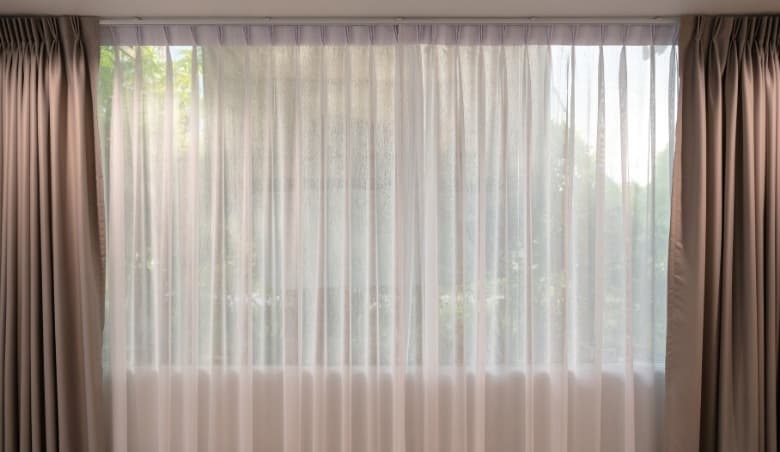
Café curtains and tailored pleats returning. Café curtains and more structured, tailored pleat headings are both appearing again in current interiors coverage (5)(6), particularly in kitchens and street-facing rooms where covering only the lower half of the window works well.

None of this means you need to follow any particular trend. It just shows the range on offer in 2026 stretches from very simple wave folds through to more traditional, tailored window treatments.
Bringing it together
Start with the problem, not the style. A darker bedroom means blackout first and the heading second. 'Daytime privacy' means sheers layered with a heavier curtain or blind. Wide windows favour wave curtains, while a more structured look favours pinch pleat curtains. An existing pole points to an eyelet curtain. An existing track is more suited to pencil pleat curtains, and a cold window means checking for a genuine thermal construction.
For more style inspiration to help create your perfect home, follow us on Instagram and Pinterest. You can also search for curtains and furnishings from retailers across the market on uFurnish.com.